

How to Write a Microsoft Resume That Passes ATS and Gets Interviews 2026
The most important Microsoft resume tips are: submit a .docx file (not PDF), mirror the exact keywords from the job description, write every bullet point as Action verb + what you did + measurable result, demonstrate growth mindset through evidence rather than adjectives, and tailor your resume separately for each Microsoft division. Microsoft uses ATS to pre-screen all applications, and keyword matching determines whether a recruiter ever sees your resume at all.
Most Microsoft resume guides recycle the same five bullet points and call it advice. This guide is different. What you will find here is built around how Microsoft's ATS actually filters applications, what a recruiter sees in the first six seconds, and the specific language signals that tell a hiring manager whether you genuinely understand Microsoft's culture or just looked it up the night before applying.
How Microsoft screens resumes in 2026
Before a Microsoft recruiter reads a single word of your resume, it goes through an Applicant Tracking System. Microsoft uses enterprise ATS platforms including Workday and internal proprietary tools that parse your document for keywords, job title alignment, and structural signals. Candidates with identical experience frequently get different outcomes based purely on formatting and keyword choices.
After the ATS filter, a recruiter spends approximately six to ten seconds on an initial scan. They are not reading sentences. They are skimming for three signals in a specific order:
- Job title relevance at current and recent roles
- Company names and the implied scale of experience those names represent
- Numbers - any numbers - that signal measurable output rather than activity
If those three things land well in the first scan, the recruiter reads the bullet points. If not, they move on. This is not a flaw in the process. It is the reality of a company hiring across Azure, Office, Xbox, LinkedIn, GitHub, and Dynamics simultaneously from a single careers portal.
Submit your Microsoft resume as a .docx file unless the job posting specifically requests a PDF. Microsoft's ATS parses Word documents more reliably, and complex PDF layouts with multiple columns, tables, or icons frequently cause parsing errors that strip your content before any human sees it. Use Calibri or Aptos at 10.5 to 11pt - these are Microsoft's own default fonts and parse cleanly in every environment.
Microsoft resume format rules that actually matter
When it comes to Microsoft resume format, clean and parseable beats clever and beautiful every time. Here is what experienced Microsoft recruiters consistently say they care about:
Most Microsoft candidates open with an objective statement. Recruiters skip these immediately. Replace it with a two to three line professional summary that names your level, your specialisation, and one specific quantified achievement. That combination gives the recruiter something to remember in those first critical seconds of scanning.
How to write a Microsoft resume: step by step
These steps reflect how the strongest Microsoft applicants approach resume writing - starting with the level and working backward to the content, rather than starting with an existing resume and hoping it passes.
The 70/30 rule: balancing technical and cultural content
A useful framework for calibrating any Microsoft resume: aim for roughly 70% technical content and 30% cultural or behavioural content. A resume that skews too technical reads as someone who can execute but may struggle in Microsoft's cross-functional, collaboration-heavy environment. A resume that skews too cultural reads as someone who cannot actually do the job.
This ratio shifts slightly by role. A PM role at Microsoft leans closer to 55/45. A Principal Engineer role on Azure leans closer to 80/20. The key insight is that neither end should read as zero.
Keywords Microsoft's ATS is scanning for in 2026
Microsoft's ATS matches against the specific job description, but it also maintains a broader skills bank associated with Microsoft's product ecosystem. Candidates who demonstrate familiarity with Microsoft's own tools - even when applying to roles that don't technically require them - consistently score better in automated filtering.
Cloud and infrastructure keywords for Microsoft roles
Productivity and collaboration stack keywords
Cultural and behavioural keywords Microsoft recruiters respond to
Action verbs that land well at Microsoft
Microsoft recruiters respond to verbs that signal measurable impact and cross-team collaboration, rather than pure execution. The highlighted verbs below are particularly aligned with Microsoft's cultural language:
How to write Microsoft resume bullet points that pass both filters
Your bullet points have to survive two entirely different readers: an algorithm scanning for keyword signals, and a human looking for evidence of impact. Most candidates optimise for one and fail the other. The formula below works for both.
Structure every bullet using this pattern: Action verb + what you did + how you did it + measurable result.
"Responsible for managing the deployment pipeline and helping the team deliver projects on time."
"Architected a CI/CD pipeline using Azure DevOps and GitHub Actions, reducing deployment time by 65% and cutting production incidents by 40% over two quarters."
"Collaborated with cross-functional teams to improve the customer experience across multiple products."
"Partnered with UX, engineering, and customer success teams to rebuild the onboarding flow in Microsoft Teams, increasing 30-day user retention by 18% across enterprise accounts."
"Worked on improving team culture and mentored junior developers when needed."
"Ran weekly knowledge-sharing sessions for 6 junior engineers on Azure architecture patterns, reducing onboarding time by 3 weeks. Two mentees promoted to mid-level within 12 months."
Estimate, and say so. "Reduced infrastructure costs by approximately 30%" is more credible than an unverifiable exact figure, and far stronger than no number at all. Recruiters understand not every candidate has access to precise dashboards. What they cannot overlook is a complete absence of any quantification across an entire resume.
Level-specific Microsoft resume strategy (L59 to L65+)
Microsoft uses a formal engineering level system from 59 (entry-level) up through Principal Engineer and Distinguished Engineer. The resume expectations shift considerably at each band. Sending a generic resume without understanding your target level is one of the most common and avoidable mistakes in a Microsoft application.
| Level | Role examples | What the resume must show |
|---|---|---|
| L59 (Entry) | SDE I, Analyst I, Associate PM | Academic projects, internships, personal builds, and certifications. Demonstrate learning pace and intellectual curiosity. One page only. Every bullet should show initiative, not just participation. |
| L60 (Junior) | SDE I with 1-2 years, Junior PM | Early career wins with individual ownership of specific features or components, not just team membership. Quantify impact even on small projects. |
| L61-62 (Mid) | SDE II, PM, Senior Analyst | Scope of individual decision-making. Show that you made technical or product decisions, not just executed others' plans. Cross-team collaboration starts to matter explicitly here. |
| L63-64 (Senior) | Senior SDE, Senior PM, Principal | People impact is now required: mentorship, hiring contributions, and team development. Systemic changes, not just project delivery. Resume can extend to two pages at this level. |
| L65+ (Principal) | Principal Engineer, Director PM | Organisation-wide or industry-level influence. Patents, published work, conference talks, evidence that you shaped how teams or the industry thinks. Depth of technical vision over breadth of tasks completed. |
Use Levels.fyi to confirm the compensation band and typical experience profile for your target level. An L62 resume that reads like an L60 will not advance, even if your actual experience is at L62. The level framing starts in your summary and runs through every bullet point.
How to show growth mindset on a Microsoft resume
Growth mindset is the single most referenced cultural concept in Microsoft's hiring process, across every division from Azure to Xbox. Satya Nadella made it the centrepiece of Microsoft's cultural transformation after 2014, and it has remained the dominant lens through which culture fit is evaluated at every level.
The problem is that "growth mindset" has been so overused that writing the phrase itself signals nothing to an experienced recruiter. What actually signals it is evidence of three specific behaviours on the page:
"Growth mindset isn't a buzzword at Redmond. It is the operating principle - and candidates who can demonstrate it through outcomes rather than adjectives are the ones who advance."
- Active learning outside your job description: new tools or certifications acquired specifically to solve a real problem, not for a promotion.
- Visible recovery from failure: a bullet that describes something that went wrong and what changed as a result. Rare on resumes, genuinely powerful at Microsoft.
- Teaching others what you learned: knowledge transfer, documentation, internal talks, or mentorship that multiplied the impact of something you figured out yourself.
"Continuous learner passionate about professional development and staying current with technology trends."
"Self-taught Rust to address performance bottlenecks in a legacy Java service, reducing latency by 40%. Subsequently ran three internal workshops to transfer the approach to the broader backend team."
The second version shows the learning, the application, and the multiplication of that learning through others. That is the complete growth mindset signal in a single bullet point.
Resume mistakes that kill Microsoft applications
These are patterns seen repeatedly by Microsoft recruiters. None of them are entry-level errors. They appear most often on resumes from experienced candidates who assume their track record speaks for itself.
"Managed the Azure infrastructure team" tells a recruiter nothing about your contribution. How many people? What did the infrastructure support? What changed because of your management? Every bullet needs to land on a result, not a description of your role.
Reframe every bullet to answer the question: "So what?" If you managed infrastructure, say what it supported and what measurably improved under your ownership.
Team achievements written in plural obscure individual contribution. Microsoft interviewers probe individual ownership hard in follow-up conversations. A resume full of "we shipped" and "we built" gives them nothing to probe and signals possible credit inflation.
Write in first person singular throughout. "Led a team of 4 to deliver X" is both accurate and individual. You can acknowledge team context without sharing the verb.
A resume written for an Azure PM role will not pass ATS screening for a GitHub developer experience role. The keyword sets, cultural signals, and technical emphasis differ meaningfully by Microsoft division. The ATS matching is role-specific.
Keep a master resume and create targeted versions for each application. Change the summary, reorder your most relevant bullet points to the top of each role, and update the skills section to match the exact language of the JD.
Listing Word, Excel, and PowerPoint wastes space that could demonstrate real differentiators. It also signals to Microsoft recruiters that you padded the skills section, which makes them question what else was padded.
Replace basic tools with role-relevant Microsoft ecosystem tools: Power BI, Azure DevOps, Dynamics 365, GitHub Copilot, or Viva Insights - tools that are directly relevant to Microsoft's product stack and signal genuine familiarity with the platform.
A resume that never references Azure, GitHub, Microsoft 365, Teams, or any Microsoft tool reads as someone who has never engaged with the platform you are applying to build or support. Even non-technical roles benefit from ecosystem familiarity signals.
If you have used any Microsoft product professionally, name it in context. If you haven't, acknowledge the product area you are targeting in your summary and describe why your transferable experience positions you to contribute to it.
Candidates who open directly with work experience force the recruiter to guess which part of Microsoft's vast business they are targeting. At a company spanning Xbox, Surface, Azure, LinkedIn, and GitHub, that ambiguity frequently results in an immediate pass.
Write two to three lines naming your level, your area of focus, and one specific achievement. Example: "Senior software engineer with 8 years building distributed systems on Azure. Led the architecture of a real-time data pipeline that reduced customer-facing latency by 55% at scale across 12 million daily users."
Microsoft certifications that actually strengthen your resume
Microsoft certifications from Microsoft Learn carry direct weight with Microsoft recruiters because they are created and maintained by Microsoft itself. These are not generic third-party certifications - they signal that you already operate within Microsoft's ecosystem and standards.
| Certification | Best for | Resume impact |
|---|---|---|
| AZ-900 Azure Fundamentals | Any candidate targeting cloud or technical roles at Microsoft | Signals baseline Azure familiarity. Particularly valuable for candidates pivoting into Microsoft from non-cloud backgrounds. |
| AZ-204 Azure Developer Associate | SDE and backend engineering candidates | Demonstrates hands-on Azure development skill. Strong ATS keyword: "Azure Developer Associate." |
| AZ-305 Azure Solutions Architect Expert | L63+ SDE and principal engineering candidates | Signals architectural depth. Among the most respected certifications in Microsoft's own hiring rubric for senior roles. |
| PL-300 Power BI Data Analyst | Data, analytics, and business intelligence roles | Directly relevant for any role involving Microsoft's data stack. Strong resume signal for PM and analyst candidates. |
| MS-700 Managing Microsoft Teams | Operations, IT, and enterprise technology roles | Signals deep familiarity with Microsoft's primary collaboration platform. Relevant for enterprise technology and operations hires. |
Every certification listed above has a complete, free study path available at learn.microsoft.com. The exam vouchers carry a cost, but the preparation material is entirely free and structured around the same competencies Microsoft tests internally. Starting a certification path before you apply signals forward momentum even if you haven't completed it yet - list it as "In progress" with the expected completion date.
Pre-submission checklist: run through this before you apply
Every item below has a direct impact on whether your Microsoft resume advances past the first filter. Check them off before submitting any application.
- Saved as FirstName-LastName-Resume.docx in a single-column layout with no tables, icons, or graphics
- Professional summary is two to three lines naming your level, specialisation, and one quantified achievement
- Every bullet point leads with an action verb and lands on a measurable result
- At least one Microsoft product or tool is referenced in the experience section in genuine context
- Keywords from the specific JD appear in the skills section using the exact phrasing from the posting
- The word "we" does not appear as the subject of any bullet point
- Cultural signals appear through evidence and outcomes - not through adjectives like "collaborative" or "passionate"
- LinkedIn URL in the header is current and matches the job title framing on the resume
- Jobscan ATS match score is 75% or above against the target JD
- Resume has been read aloud once - this catches awkward phrasing that a visual read misses
Resources worth bookmarking for your Microsoft application
| Resource | What it's for | Cost |
|---|---|---|
| Microsoft Careers Portal | The only place to submit your application officially. Read each JD carefully for exact keywords, level indicators, and product area signals before tailoring your resume. | Free |
| Levels.fyi - Microsoft Salary Bands | Self-reported compensation data by level and role. Use this to identify your target level before writing your resume and before salary negotiation. Knowing L61 vs L63 expectations in advance is a significant advantage. | Free |
| Microsoft Learn - Certifications | Official Microsoft certification paths for Azure, Power Platform, Dynamics, and security. These certifications are directly recognised by Microsoft recruiters and add genuine ATS weight to your resume. | Free |
| Jobscan ATS Scanner | Paste your resume and a Microsoft JD side-by-side to get an ATS match score and a missing keyword report. One of the fastest ways to identify gaps before submitting an application. | Free |
| Glassdoor - Microsoft Reviews | Recent interview experience reports and recruiter feedback patterns by role. Useful for aligning your resume to what the current interview process actually probes. | Free |
| Exponent - Microsoft SWE Guide | Level-specific prep guidance including what interviewers at each band are specifically looking for. Useful for calibrating resume emphasis after confirming your target level. | Free |
| IGotAnOffer | Real candidate experience reports including feedback received from Microsoft recruiters. One of the most accurate sources for understanding what Microsoft hiring managers comment on during debrief calls. | Free |
| Fortune Vacancies - Microsoft Jobs | Up-to-date Microsoft job listings across all divisions, levels, and global locations. Bookmark this to track new openings in your target function as they go live - and to read the JD language before tailoring your resume. | Free |
Ready to find your Microsoft role?
Browse current Microsoft job openings across all divisions, levels, and global locations, updated daily.
Frequently asked questions about Microsoft resumes
These are the questions candidates most commonly ask before submitting their Microsoft resume. Each answer is written to be direct and actionable.
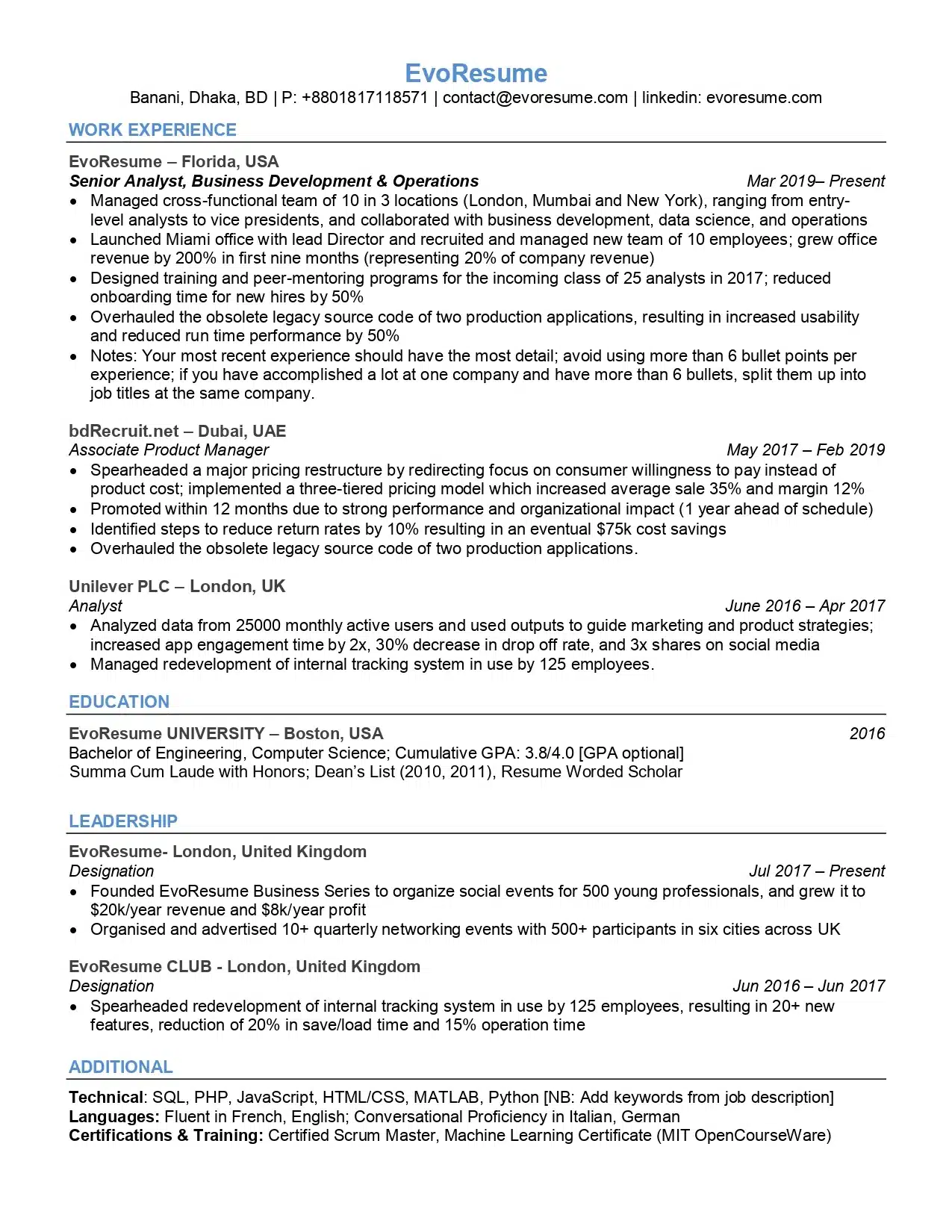
Built to clear the ATS filters at Microsoft, Google, Amazon, and other top employers. Editable .DOC file ready to fill in, no design skills needed.
- Single-column ATS-safe layout
- Correct section order recruiters expect
- Pre-loaded power action verbs
- Keyword-ready skills section
- Compatible with Microsoft Word
- Built for 2026 hiring standards